
Data centre requirements do not always fit neatly within a traditional facility. Organisations may need additional capacity quickly, computing infrastructure in a remote location, or greater flexibility to respond to changing demand.
Containerised data centres provide a practical solution to these challenges. By housing critical IT infrastructure within a purpose built, transportable enclosure, they allow organisations to deploy capacity closer to where it is needed without relying solely on conventional data centre construction.
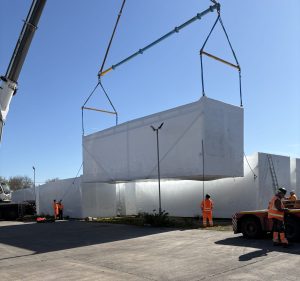
Oper8 Containerised Data Centre
But when are containerised data centres actually used?
Expanding existing data centre capacity
One of the most common applications is expanding capacity at an existing data centre.
As demand increases, organisations may find that their current facility no longer has sufficient space for additional IT equipment. Extending the building can involve considerable construction, disruption and lengthy project timelines.
A containerised data centre can provide additional capacity alongside the existing facility. Its modular design also allows further units to be introduced as requirements grow, helping organisations expand infrastructure progressively rather than building significantly more capacity from the outset.
Remote and Challenging Locations
Not every organisation requires its computing infrastructure within a conventional data centre building.
Energy sites, industrial facilities, construction projects and other remote operations can all require reliable IT infrastructure, sometimes in locations where constructing a permanent facility would be impractical.
Containerised solutions can be transported to the required locations and configured with the power, cooling, monitoring and security systems necessary to support critical equipment.
This enables organisations to bring computing resources closer to the operations they support.
Edge computing
The growth of edge computing is creating another use case for containerised infrastructure.
Rather than sending all information to a central data centre for processing, edge computing brings computing resources closer to where data is generated. This can be valuable for connected equipment, industrial environments and other data-intensive applications.
Containerised data centres can support this distributed approach by providing dedicated IT capacity at or near operational sites.
Temporary and Project-Based Requirements
Some infrastructure requirements are temporary rather than permanent.
An organisation may need additional capacity during a particular project, while an existing facility is being upgraded, or at a location whose long-term requirements remain uncertain.
Developing an entirely new permanent data centre may not make sense in these situations. A transportable, modular environment provides another option, allowing infrastructure to be developed without committing to a full traditional build.
Supporting Data Centre Modernisation
Modernising an operational data centre can be complex, particularly when critical services need to remain available throughout the project.
Containerised infrastructure can provide supplementary or transitional capacity while existing equipment, power systems or cooling infrastructure is upgraded.
This means the container does not necessarily have to replace the existing facility. Instead, it can form part of a wider modernisation strategy, helping organisations introduce new capacity while minimising disruption to ongoing operations.
Business Growth and Scalability
IT requirements rarely remain static. Business expansion, increasing data volumes and new technologies can all create demand for greater computing capacity.
Containerised data centres allow infrastructure to be expanded in stages. Rather than designing a large facility around predicted future demand, organisations can introduce additional modules as requirements develop.
This makes the approach particularly useful when future growth is expected but the exact level of capacity required is difficult to predict.
When Does a Containerised Approach Make Sense?
A containerised data centre can be particularly valuable when:
- Additional capacity is needed quickly
- Existing data centre space is limited
- IT infrastructure is required in a remote location
- Future capacity requirements are uncertain
- Infrastructure needs to expand progressively
- Additional capacity is required during a modernisation project
The right approach ultimately depends on the location, IT load, resilience requirements and longer-term infrastructure strategy.
Oper8 Global designs and delivers containerised data centre solutions tailored to individual capacity, resilience and operational requirements.