
As organisations become increasingly reliant on connected devices, digital services and data-driven applications, IT infrastructure is no longer always concentrated within one central location.
Manufacturing sites, offices, healthcare environments, retail locations and remote facilities can all generate and process significant amounts of data. In some situations, sending everything back to a centralised data centre or cloud environment may not be the most appropriate approach.
This is where micro data centres can play an important role.
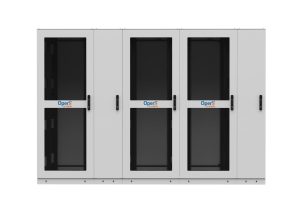
Rather than requiring a full-scale data centre facility, a micro data centre provides a compact environment for critical IT infrastructure at, or closer to, the location where computing capability is required.
But where are micro data centres actually used?
Manufacturing and industrial environments
Modern manufacturing facilities increasingly rely on connected equipment, automation, sensors and digital monitoring systems.
These technologies can generate significant amounts of operational data directly on the factory floor. A micro data centre can provide local computing infrastructure to support these systems without requiring the organisation to build a dedicated traditional data centre.
Their compact footprint can also make them particularly useful within industrial environments where available space may be limited.
Edge computing applications
One of the most significant applications for micro data centres is edge computing.
Edge computing involves processing data closer to where it is generated rather than relying exclusively on a distant central data centre or cloud platform.
A micro data centre can provide the physical infrastructure required to support this local computing equipment, including appropriate power, cooling, monitoring and physical protection.
This makes micro data centres particularly relevant to organisations operating across distributed location or using applications that require computing resources closer to users, equipment or connected devices.
Offices and commercial buildings
Not every organisation requiring dedicated IT infrastructure has the space or requirement for a traditional data centre.
Micro data centres can provide a way of supporting servers, networking equipment and other critical IT systems within offices and commercial environments.
Their smaller footprint means infrastructure can be introduced into locations where constructing a dedicated data centre room would be impractical, while still providing a controlled environment for the equipment.
Healthcare environments
Healthcare organisations depend on a growing range of digital systems, connected equipment and data-intensive applications.
Where local IT capability is required, micro data centres can provide dedicated infrastructure without requiring a large data centre environment.
The ability to integrate power, cooling, monitoring, security and backup systems within a compact solution can also help protect the critical IT equipment supporting these applications.
Retail and distributed locations
Retail organisations can operate across tens, hundreds or even thousands of individual locations.
Each site may depend on IT infrastructure supporting systems such as transactions, inventory management, security technology and connected devices.
Instead of relying entirely on infrastructure located elsewhere, micro data centres can provide local computing capability at individual or strategically selected locations.
They can therefore form part of a wider distributed IT strategy, allowing organisations to deploy infrastructure across multiple sites as requirements develop.
Telecommunications
Telecommunications infrastructure is inherently distributed, making local computing capability important across a range of locations.
Micro data centres can provide protected environments for IT and networking equipment closer to where telecommunications services are being delivered.
The compact nature of the infrastructure can be particularly useful where conventional data centre space is unavailable or unnecessary.
Remote and space constrained sites
Some of the strongest use cases for micro data centres are locations where a traditional data centre simply isn’t practical.
A remote operational site, for example, may still require local computing capability despite having limited space or limited access to central IT facilities.
Similarly, an existing building may need additional IT infrastructure but have insufficient room for a conventional data centre environment.
A micro data centre provides an alternative by creating a dedicated environment around the equipment itself rather than requiring an entire room or facility to perform that function.
When does a micro data centre make sense?
A micro data centre may be worth considering when an organisation needs:
- IT capability across multiple locations
- Computing closer to users, equipment or devices
- Infrastructure within a space constrained environment
- A controlled environment for critical IT equipment
- A flexible approach that can be adapted around individual sites
- Local computing capability without developing a full-scale data centre
The right approach will ultimately depend on the IT load, available pace, resilience requirements, site conditions and future capacity requirements.
Explore micro data centre solutions
Want to understand how a micro data centre could support your infrastructure requirements?